Sunday, September 2, 2012

Recent Readings: Catherine Opie & Richard Misrach

Opie, Catherine, Nat Trotman, and Russell Ferguson. Catherine Opie: American Photographer. New York, N.Y: Guggenheim Museum, 2008. 

Misrach, Richard, and Susan Sontag. Violent Legacies: Three Cantos. New York: Aperture, 1992.


Misrach: "But I've come to believe that beauty can be a very powerful conveyor of difficult ideas. It engages people when they might otherwise look away. Recent theory has been critical of the distancing effect of artistic expression - 'create solutions, not art.' But the impact of art may be more complex and far-reaching than theory is capable of assessing. To me, the work I do is a means of interpreting unsettling truths, of bearing witness, and of sounding alarms. The beauty of formal representation both carries an affirmation of life and subversively brings us face to face with news from our besieged world." (90)


Saturday, August 25, 2012

Horizons cont.


Inverted horizons

Since I often find myself going into the water to photograph, I've become interested in looking at the water line below the surface as an inverted horizon line. I researched Hiroshi Sugimoto for my first comparative analysis paper and I keep coming back to his Seascapes where he captured the horizon line above water. Here are a few initial samples working with the idea of an inverted horizon.


Sunday, August 19, 2012

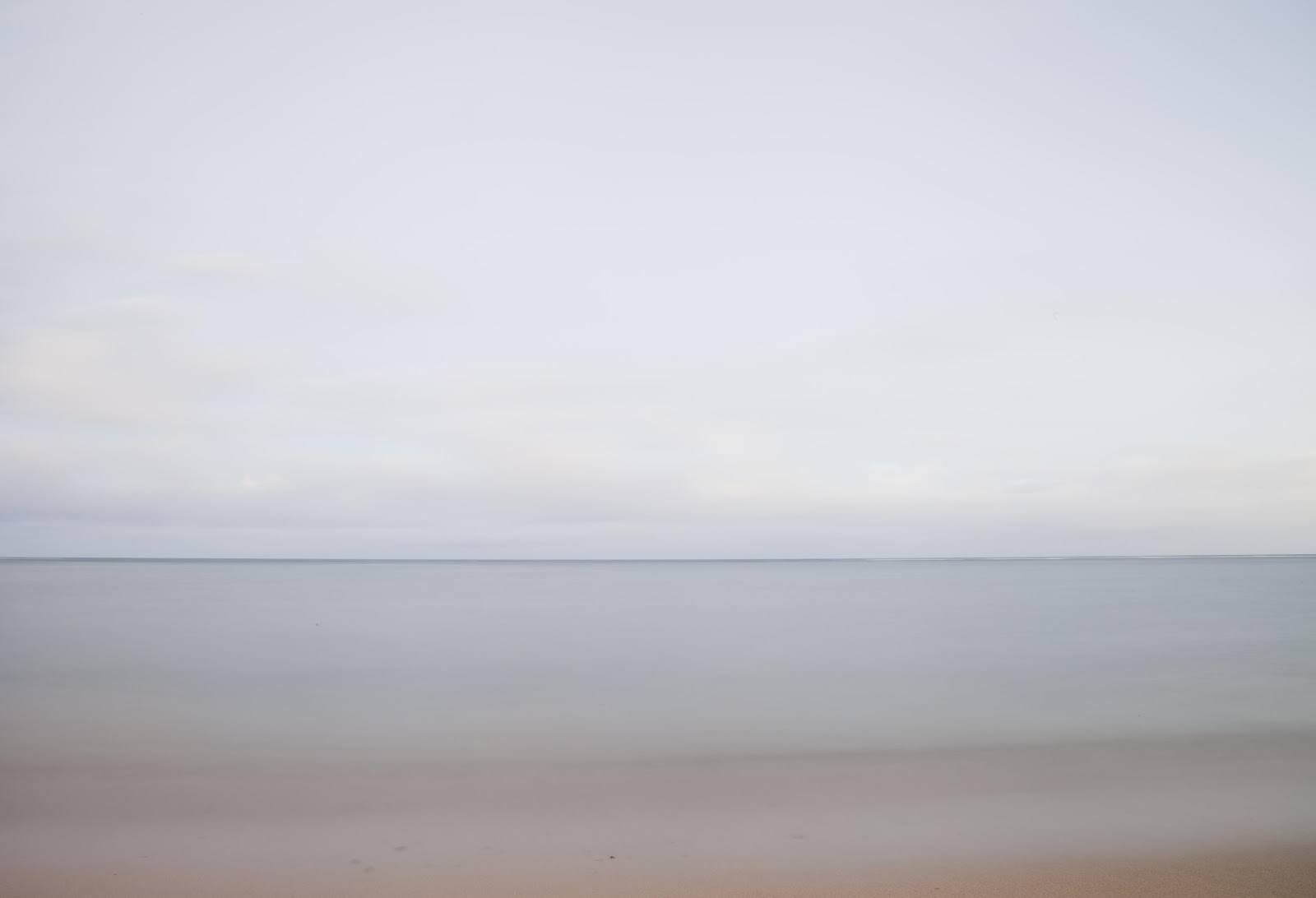
New work: Horizons

I've been experimenting with long exposures photographing late at night. I keep coming back to the horizon line. I know it is the meeting point of air and water, but it is often difficult to make out clearly, to really SEE it. Vast, unknown, intriguing. I also like the idea of extending time using long shutters and having enough patience to make an image with very little light. The images are around 3-10 minutes each.


Artwork I'm looking at

1st comparative analysis paper is coming up due this month. I'm looking at the work of Richard Misrach and Hiroshi Sugimoto. In particular, I will be comparing the two photographs below.


1. Untitled
By Richard Misrach
2002
 49 x 111 inches


2. Seascape: Sea of Japan
Hirsohi Sugimoto
1997

Current Readings

The Sublime by Simon Morley

The American Technological Sublime by David E. Nye


Sunday, August 12, 2012

On Hawaiian Thought & Art


Quote by Meleanna Aluli Meyer
"The responsibility that comes with the making of art is profound in that we are challenged to envision with all of our senses, not only for ourselves, but for those past, present, and to come. Art is the most natural extension of self with Akua [living essence, spirit, god] , with the inner and outer, and to all things seen and unseen. By actively creating, we become stewards among many things... of nature, of our thoughts, hopes, and expressions, of community ethos, of cultural representations, histories, etc."

Recommended texts:
  • Cazimero, Momi, la T. D. J. De, and Manulani A. Meyer. Nā Maka Hou: New Visions : Contemporary Native Hawaiian Art. Honolulu: Honolulu Academy of Arts, 2001. 
  • Charlot, John. Chanting the Universe: Hawaiian Religious Culture. Hong Kong: Emphasis International, 1983.
  • Forbes, David W. Encounters with Paradise: Views of Hawaii and Its People, 1778-1941. Honolulu: Honolulu Academy of Arts, 1992.
  • Yoshihara, Lisa A. Collective Visions, 1967-1997: An Exhibition Celebrating the 30th Anniversary of the State Foundation on Culture and the Arts, Art in Public Places Program, Presented at the Honolulu Academy of Arts, September 3-October 12, 1997. Honolulu, Hawaii: The Foundation, 1997. 
Local artists I am interested in learning more about:
  • Maile Andrade
  • Ke'alaonaonapuahinano Campton
  • Herman Pi'ikea Clark
  • Kapulani Landgraf
  • Meala
  • Meleanna Aluli Meyer
  • Macario Timbal
  • Yvonne Cheng
  • Francis Harr
  • Anne Kapulani Landgraf
  • David Ulrich
  • Allyn Bromley
  • Tadashi Sato
  • Murray Turnbull
  • Keichi Kimura
  • Wayne Levin
  • Hiroki Morinoue
  • Mark Hamasaki
  • Jan Becket
  • John Wisnosky
  • Stan Tomita & Karen Kosasa
  • Paul Kodama
  • Franco Salmoiraghi
  • Alan Leitner
  • J. Halley Cox
  • Les Biller
  • Laura Ruby
  • Boone Morrison

Thursday, August 2, 2012

Mentor Meeting with David Ulrich


I just finished my first mentor meeting with David Ulrich (www.creativeguide.com.) Although David and I have known each other for a few years now, today marks our first official meeting with AIB’s mentor program. I am very fortunate to be working with David again and to also have an experienced mentor, educator, and artist living and working locally in Honolulu, HI.

I’m walking away from our first meeting with a number of ideas. David suggested a list of pertinent literature about Hawaiian contemporary art and philosophy that I will post soon. He mentioned the importance of recognizing my unique location here on Oahu – I am an artist/student living within a melting pot of both Western and Eastern philosophies. While I am engaged in an MFA program based on the east coast of the United States, I am living and working within a community in the Pacific influenced by a rich Polynesian and Hawaiian culture.  As I study the notion of sublime, it is important to acknowledge the very idea of sublime as a Western cultural construct. In relation to Hawaiian and Polynesian culture, the sublime is in fact embedded into every dimension of life. Thus, in an effort to better understand the sublime and how it relates to both the people and landscape of Hawaii AND my own approach to making artwork here, I need to read up on number of local literature and artists. I will be researching how other local artists look at, understand, work with, and portray the notion of sublime.

David had a chance to browse a book I am currently reading, Simon Morley’s “The Sublime.” An important quote by Morley in his introduction on the discourse of sublime reads, “Methodologically, the sublime may be invoked performatively in some texts, while at the other extreme it will be analyzed through the abstract and detached lens of philosophy. Several texts can clearly be located with a residually religious, mystical, or spiritual discourse, while others take a more sociological and even Marxist perspective in exploring the centrality of the concept of the sublime to postmodern culture as a whole. Some texts approach recent history as itself a sublime experience, while others address problems posed by science and technology. All these perspectives are deepened by the application of psychoanalytic theories, and by revisions of received knowledge and belief arising from feminist, ethnic, and non-Western critique. Ultimately, the sublime is an experience looking for context.” (21)

Morley acknowledges evolving understandings of the sublime, and most pertinent to my work (and location), he suggests “ethnic and non-Western critique” as important contributions to the discourse. This is where gaining a deeper understanding of Hawaiian and Polynesian cultures may come into play as approach the broad and massive topic of the sublime.

Morley concludes, “In the pre-modern period, this context [of the sublime] was mostly provided by religion. From around the Romantic era onwards, some forms of art took on this role. And more recently, spectacle and mass media have given the sublime a new if not unproblematic home. The sublime is an experience that can serve many interests; it is now for us to decided what it holds for the future.” (21)

Work-wise, David and I discussed the importance of staying open to multiple strains of thought and exploring many projects this fall… although it is already apparent that threads exist between ideas. Currently, I am looking at:
•                Constructed/commercialized sublime in Hawaiian tourism industry
•                Escapism
•                The sublime (…broad and massive topic here but keeping this theme open for possibilities)
•                Water & air experiments (& perhaps how these relate to sublime experiences)


Thursday, July 26, 2012

Photojournalist Hugh Gentry Talk

I attended a lecture tonight by Hugh Gentry at Pacific New Media and was reminded again of how rapidly the fields of photography (in this case photojournalism & commercial) are changing. Powerful SLRs, camera equipment with video capture, the Internet, iPhones have all change how we approach image making and  image viewing. Overall, I enjoyed Hugh Gentry's talk and I was especially interested in hearing about his underwater work shooting the Ironman. It was fun to step away from the modern fine art world and walk into the fast-paced action of photojournalism and diverse assignment and travel shooting.

Quick bio pulled from Pacific New Media website:
"Hugh Gentry is a freelance photojournalist and videographer working as a stringer for Reuters and the Associated Press as well as the major television networks. His client list also includes National Geographic, Discovery Channel, Travel Channel, and Land Rover. He started his career as a TV news cameraman and in 2003 transitioned into digital photography. By combining both skills, he can deliver multiple content formats to a diverse range of clients. He specializes in shooting underwater, surfing, and adventure sports."


Tuesday, July 24, 2012

Vintage Postcards: Depictions of Hawaii

Went down to Bailey's Antiques and Aloha Shirts down on Kapahulu today (http://alohashirts.com/)  to start some research on vintage postcards of Hawaii. With ideas of escapism and tourism in mind, I'm interested in what kinds of postcards visitors were sending back to friends & family. What types of images were portrayed and even better, what were visitors to the islands writing about their experiences, vacations, or deployments? What role did/do postcards play in the exoticism of Hawaii?

I talked to the store owner and learned that in the last 15-20 years vintage Hawaiian postcards have become really expensive, anywhere from $5-100 a piece!!! Whoa, that's a bit out of my league at the moment. I did have a chance to browse a handful of albums with vintage postcards and it was fascinating to see old landscapes and cityscapes. So much has changed and developed.  It's clear now why these seemingly mundane objects have value as historical documents of a time and place.  I found interesting that most of the postcards (at least at this shop) were simple images without any text - many were straight photographs. Seems to me that nowadays many postcards have some kind of cheesy tagline like "Mai Tai Time" or "Aloha from Paradise!" Perhaps, over time the tourism industry started including text when it realized that postcards are an ideal source of free advertising.
http://postcardparadise.blogspot.com/2010/11/were-off-to-hawaii.html
    
http://www.janesoceania.com/hawaii_vintage_postcards10/index1.htm
As far as budget is concerned, I may have to stick with representations of Hawaii in modern-day postcards. Next stop for postcards: ABC Store in Waikiki.

I did find and purchase a $2 United airlines postcard and will scan it shortly. One line from the caption on the back reads "For most people, a visit to Hawaii is not just a routine trip but fulfillment of long-held expectations." This phrase caught my eye because in David Nye's "American Technological Sublime" he considers Clarence Dutton's views on how initial expectations play into, or disrupt, our experience of the sublime. Nye writes,"Ideally, it might seem that the sublime should be an unexpected encounter, a largely unmediated experience of discontinuity between the self and the startling natural object. Because the travel is so prepared in advance, the sublime may seem to be swallowed up by representations in the mass media. Only a prolonged reexperiencing of the site can overcome the egotistical demands of the informed visitor." (15)

Food for thought!

Sunday, July 22, 2012

2 Sketches: Motion in Air

While I was traveling back home and spending time in the Pacific Northwest, I stumbled upon a few children jumping into a lake. At the time, I wasn't planning to make images, but I was intrigued with how beautiful the motions in the air looked against the (almost) cloudless sky. I cropped out any hints of the diving platform and avoided shooting the horizon. These two shots feel like sketches or brainstorms for something to explore in the future. They also feel similar in many ways to my work in water - the human form in a sort of weightless, surreal world. I'll have to look into experimenting with more images of freefall and/or jumping.


Wednesday, July 18, 2012

Marilyn Minter: Attraction/Repulsion/Seduction


At this June’s residency, I was encouraged by Oliver Wasow to discover the work of Marilyn Minter. I checked out the book below from AIB’s library before leaving Boston. One can approach Minter’s work from a variety of angles, but at this moment I am most interested in considering how her work tackles the dualities of attraction/repulsion and realism/fantasy. Since I’m particularly interested in exploring the notion of sublime as the intersection of absolute beauty (awe, wonder, etc) and terror (fear, ugliness, unknown), Marilyn Minter’s work has acted as a launch pad for my research.


  • Minter, Marilyn.
  • Marilyn Minter. New York: Gregory R. Miller & Co, 2007 
    Artist’s quote on glamour and its tricks:
    “Everybody I know gets so much pleasure from looking at glamorous pictures, movies, videos – but at the same time, you are always aware that you are never going to live like that, look like that, or be like that. You can get pleasure out of it, yet it can make you feel very insecure. I think that a lot of my work is trying to articulate what that insecurity combined with pleasure feels like. The sexy underside? Well, that might be inherent in taking things apart because that is where things start to get untidy and messy. So even though the glamour we see in popular culture is so perfect and flat, when it starts to come undone perhaps it gets sexier.” (Pg. 62)

    Artist’s quote on the NYC Billboards project:
    "I'm trying to make an image of what it feels like to look. I want to make a fresh vision of something that's compelling; something that commands our attention; something that is so visually lush that you'll give it multiple readings adding your own history and traditions to the layered content. Some things make you feel transcended; others make you feel slimed. I'm constantly looking for that transcendent moment." (Pg. 36)
    Interesting fact: I learned that both Jan Avgikos (current AIB faculty member) and Marilyn Minter were part of an intellectual group in the early 1990’s focusing on issues of sexuality, pro-sex feminism, and pornography. I feel privileged to have had the opportunity to do a group critique with Jan this past June.

    Green Pink Caviar Trailer: http://www.greenpinkcaviar.com/index.php

    Saturday, July 7, 2012

    Seattle Art Museum & Olympic Sculpture Park


    I am making my way back to Oahu after this June’s intensive residency and am currently visiting my sister in Seattle. Yesterday, we had a chance to visit the Seattle Art Museum. The exhibition titled “Ancestral Modern: Australian Aboriginal Art from the Kaplan & Levi Collection” was incredible. The canvases were breathtaking, dizzying, and rich with storytelling symbols passed on through a culture that is believed to have originated as early as 50,000 years ago. Notes from Laurel Spark’s lecture during the June residency on “Abstraction and Meaning” resurfaced in my mind. What appears remarkably modern at first is in fact directly rooted in an ancient, dynamic, and abstract visual language.   Check out: Kutungka Napanangka (Old Woman Dreaming), 2004 http://www.seattleartmuseum.org/ancestralmodern/ 

    As a side, in the contemporary wing of the SAM, I also enjoyed viewing the new acquisition of Reneke Dijkstra’s matador portraits. Three male (presumably heroic) subjects were photographed not in the traditional stadium but against an unassuming beige wall appearing vulnerable and fatigued.
    Check out: Rineke Dijkstra Vila Franca de Xira, Portugal, May 8, 1994 

    We also had the opportunity to browse the Olympic Sculpture Park. It is definitely worth a visit to experience this outdoor space filled with large sculpture against the scenic backdrop of the Puget Sound and Olympic Mountains. Artists featured include Richard Serra, Claes Oldenburg, Coosje van Bruggen, Ellsworth Kelly, Louise Bourgeois, Alexander Calder, Mark di Suvero, Mark Dion, Teresita Fernández, Roy McMakin, Louise Nevelson, Roxy Paine, Beverly Pepper, Tony Smith, and George Rickey. Be sure to check it out if you are ever in Seattle! http://www.seattleartmuseum.org/emuseum/code/emuseum.asp?emu_action=collection&collection=6096&collectionname=WEB.Olympic%20Sculpture%20Park&currentrecord=1&moduleid=1&module=c

    Friday, July 6, 2012

    Museum Hopping in Boston


    While attending my first residency at AIB this June, I was able to take advantage of three great museums in Boston.

    ICA: Josiah McElheny: Some Pictures of the Infinite
    This was a great starting off point to begin my museum visits in Boston. Besides being an impressive space, the ICA organized an engaging show on Josiah McElheny’s “Some Pictures of the Infinite.” A variety of media attempted the impossible task of representing the unrepresentable. When I walked over to photograph one of McElheny’s chandelier sculptures, I discovered the piece had an interactive component. As I lined up my camera, I was simultaneously outside the piece and yet reflected in the mirrored bulb. My reflection was not only visible in the bulb I was focusing on, but also in every other bulb accompanying the piece. I found myself inside yet outside, independent yet part of a greater whole, grounded yet expansive. Nice work.


    MIT: ‘Joachim Koester: To navigate, in a genuine way, in the unknown...’
    I attended Ben Sloat’s field trip to view Joachim Koester’s exhibit at MIT. I was interested in learning more about Koester’s interest “in the unknown” and “what can and cannot be told.” The film installations “Tarantism” was housed in an almost completely blacked out room with jagged boards nailed against the window and set up as partitions. The photography was most interesting to me depicting mysterious scenes from a squatter community in Copenhagen and a project titled “The Kant Walks.” A revealing quote from Koester:  

    “My next days in Kaliningrad were spent on foot, following Kalinikov's walks, or Kant's - I was never sure. Drifting through the ‘subtle realms’, the 'psychogeography' of a city that officially, for more than forty years, had no past - in Soviet text and guidebooks Kant was born in Kaliningrad. Paradoxically, I found that the concealment of the city's history, made it appear even more distinct, exactly because the past was not compartmentalized as such, but seemed to turn up as 'blind spots'. Detours, dead ends, overgrown streets, a small castle lost in an industrial quarter, evoked history as a chaos, a dormant presence far more potential than tidy linear narratives used to explain past events. Nowhere in Europe are the traces after World War Two more visible than in Kaliningrad. Hauntings from a war that shaped lives and destinies for generations to come. Including my own - like many, affected by the ‘third generation syndrome’, I have always felt as if I was pulled towards an empty space: ‘that which has not been said.’”


    MFA
    On my last day in Boston, I visited the Museum of Fine Art. Having never been before, I was surprised at how large the museum was and the number of works housed here. I definitely need to plan more time next visit!
    Edward Weston: Leaves of Grass
    This was my first stop at the MFA and the room showcased a selection of images from the “Leave of Grass” project. The exhibition left me curious to view the original edition of “Leaves of Grass” with the full text and the accompanying final selection of images. In addition, it would be fascinating to see Weston’s contact sheets. A number of the images on display did not make it into the final book edition.

    Silver, Salt, and Sunlight: Early Photography in Britain and France
    Viewing early photography reminds me to recognize the skill and patience required to produce a successful image using old methods. I learned of a female British photographer, Anna Atkins, who published the first photographically illustrated book titled “Photographs on British Algae” using cyanotypes in the 19th century. Ladies represent!

    The Invention of Fantasy: 18th Century Venice
    I was interested in this exhibition due to my curiosity in exploring how places become romanticized and exoticized. I also have family in Italy, lived in Florence and Sicily, and have spent time in Venice. The drawings and prints were skillfully crafted but the idea of “fantasy” seemed to be portrayed in a more playful, theatrical sense. Although it was not what I expected, there were some comical prints on everyday Venetian life as well as a number incorporating biblical and mythological narratives.

    Contemporary Wing
    I wasn’t sure I would have enough time for this wing but I am so glad I did. A number of works were accompanied by an artist quote that resonated with me.

    Blue Green Yellow Orange Red, Ellsworth Kelly, “I think that if you turn off your mind and look at things only with your eyes, ultimately everything becomes abstract.”

    Steigend steigend sinke nieder (Rising, rising, falling down), Anselm Kiefer, “The more scarred the work of art is by the battles waged on the borders between art and life, the more interesting it becomes.”

    Tamahagane,  Henry Mandel, “Ours is a chaotic world and abstraction is my way to depict its essence.”

    Manhole, Ivàn Navarro, “My work consist[s] of (metaphorically) ‘diryting’ the purity of industrial forms.”


    Sunday, July 1, 2012

    MFA Initial Portfolio

    As a starting point for my MFA journey, I've posted a selection of images I brought to the first residency. These photographs are part of series titled "Emerge/Submerge: The Paradox of Permanence."


    1st Residency Critique Wall